
Find the help you need for any problem
- Debt basics
- Personal loans
- Rates, fees & APR
- Credit score & eligibility
- Repayment & loan payments
- Loan application
- Debt consolidation
- All articles
What Credit Score Do You Need for a Personal Loan?

You're staring at your credit score and wondering:Can I even qualify for a personal loan?Here's the honest answer—there's no magic number. No lender has posted a sign saying "650 or bust." The truth is messier: approval hinges on your credit score, yes, but also your income, job stability, debt load, and how a particular lender weighs risk. That said, don't undersell your credit score. It's still one of the loudest signals lenders hear. A strong score (740+) opens doors to the best rates and terms. A weaker score (below 600) doesn't lock you out entirely, but it does narrow your options and raise your costs. The good news? Understanding how your score fits into the bigger picture—and knowing what lenders actually care about—lets you approach your application with real clarity, not hope and guesswork.
Personal loans are among the most flexible debt products available. Unlike mortgages or auto loans tied to specific collateral, personal loans are unsecured—lenders have no asset to repossess if you default. This means they rely heavily on credit assessment to gauge risk. Your credit score is essentially a shorthand for "How likely is this person to repay?" It's not a perfect measure, but it's the fastest, most standardized way lenders evaluate thousands of applicants daily. Understanding where your score sits, what it means to different lenders, and how to position yourself for approval is the first step toward getting the right loan at the right rate.
In this article:
- What Credit Score Is Needed for a Personal Loan?
- Personal Loans for Bad Credit: Real, But Different
- How Your Credit Score Affects Your Loan
- What Lenders Consider Beyond Your Credit Score
- What to Do Before You Apply
- How to Improve Your Credit Score Before Applying
- Where Pennie Financial Fits
- Final Thoughts
- Frequently Asked Questions
What Credit Score Is Needed for a Personal Loan?
Lenders don't work from a secret playbook. Here's how the score ranges actually map to approval odds and terms:
| Credit Score Range | Approval Outlook | What to Expect |
|---|---|---|
| 300–579 (Poor) | Options available | Specialized lenders, rates depend on income profile, strong income can offset score |
| 580–669 (Fair) | Good chances | Many lenders compete for this range, rates vary widely — shopping around pays off |
| 670–739 (Good) | Strong position | Competitive rates, reasonable amounts, mainstream approval path |
| 740–799 (Very Good) | Excellent | Low rates, higher limits, favorable terms across the board |
| 800+ (Excellent) | Best available | Best-in-class rates, largest amounts, lender flexibility |
Reality check on these ranges:
These ranges track the standard FICO model, but lenders don't all use the same yardstick. Some use FICO; others use VantageScore or proprietary models. What they're all reading is the same story: your credit history. A high score says "I pay on time." A low score says "I've stumbled." Lenders price risk accordingly.
It's also worth noting that these ranges aren't universally agreed upon. One lender might consider 620 "fair" and approvable; another might treat it as a hard floor they won't cross. Some specialize in prime lending (670+) where competition is fierce and rates are best. Others focus exclusively on the subprime segment (580–669), where borrowers face higher costs but have access to credit they'd otherwise be denied. A third group operates in the deep subprime space (300–579), with even higher rates and stricter terms, but reaching borrowers nobody else will touch.
The key thing to know: some lenders hunt for borrowers in every range. Bad-credit specialists thrive on sub-600 profiles; prime lenders cherry-pick the 700s. At Pennie, we connect you with the partners best suited toyourprofile, not a generic checkbox. This means you're not guessing which lender will work for you—we've already done that homework.
Personal Loans for Bad Credit: Real, But Different
If your score is south of 580, don't assume you're shut out. Lenders who focus on this segment look past the score to ask different questions:Is your income steady? Have you been at your job long enough? Can you explain the delinquencies?Bad credit gets approved, but the terms reflect the risk.
Here's what a lot of people don't realize: a low credit score often tells a misleading story. Maybe a medical bill went to collections while you were dealing with an emergency. Maybe a single missed payment during a job transition tanked your score by 80 points. If your income is solid and the issue was a one-time event rather than a pattern, lenders who specialize in this space recognize the difference. They're not just reading a number—they're reading context. Borrowers with strong income profiles and an explainable credit event often qualify for better terms than they expected.
Bad-credit loans do come with trade-offs—rates tend to be higher and loan amounts may start smaller. But the range is wide, and your specific terms depend heavily on the rest of your financial picture. A borrower earning $55K/year with a 520 score from one medical debt is a very different risk than someone with the same score and unstable income. Lenders who focus on this segment know that, and they price accordingly.
And here's something important: a personal loan can actually be a tool for rebuilding. Each on-time payment reports to the credit bureaus, gradually raising your score. After 12–24 months of consistent payment history, many borrowers see meaningful score improvements—enough to refinance at a lower rate or qualify for better terms on future credit.
You're not stuck in the bad-credit category forever. A well-managed loan can serve as a bridge to a stronger financial position. It's a legitimate strategy—especially if you pair it with the other credit-building habits covered later in this guide.
How Your Credit Score Affects Your Loan
Four concrete ways your score shapes your offer:
1. Approval odds
A 680+ score generally clears the bar with mainstream lenders quickly and with fewer conditions. Below 600, mainstream lenders may not be the right fit—but there's a large and growing pool of lenders who specialize in working with borrowers in this range, particularly those with steady income. Within any range, every 10–20 points matters. A 680 score gets approved faster than a 650, and a 550 with strong income and a clear explanation for the score dip is a very different application than a 550 with unstable employment. Lenders increasingly evaluate the full picture, not just the number.
2. Interest rate—the money part
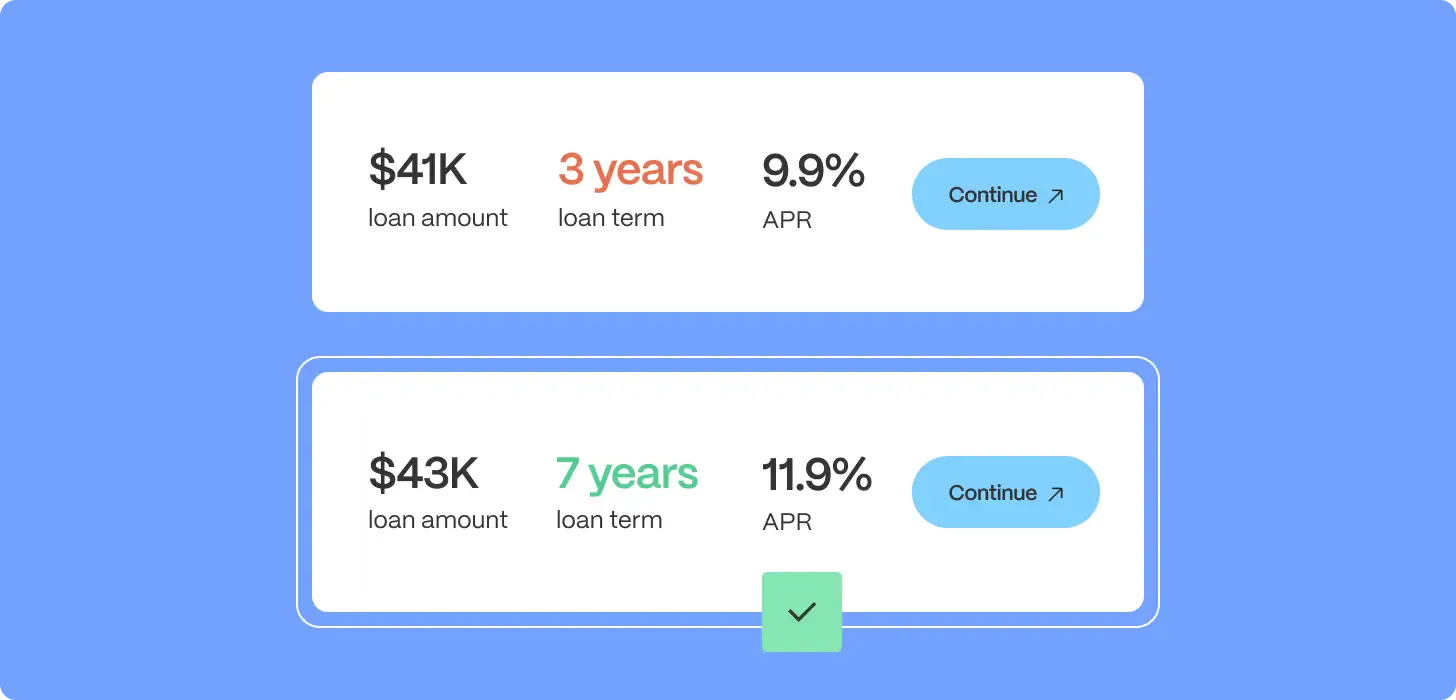
A 750 score might get you 6.5% APR. A 600 score? 15–18%. Over a 36-month $10,000 loan, that's a difference of $1,500+ in interest. Your score directly ties to what youpay. And this compounds over time. If you're considering a $15,000 loan over 48 months, the difference between 7% and 16% is roughly $3,600 in extra interest. That's real money—enough to make a meaningful dent in your budget or delay other financial goals.
3. How much you can borrow
Loan amounts depend on your full financial profile, not just your score. A borrower with a 600 score and $70K income may qualify for significantly more than someone with the same score earning $30K. Income plays a huge role here—especially in the fair and poor credit ranges, where lenders weigh earning power and debt-to-income ratio more heavily. If a single lender can't offer the amount you need, comparing offers across multiple lenders (or using a marketplace) often reveals better options. Adding a co-signer or offering collateral can also unlock higher amounts at any credit level.
4. Repayment timeline
Riskier borrowers get shorter terms—often 36–48 months—to reduce lender exposure. Lower-risk borrowers access 60–84 month terms, spreading payments thinner. Your monthly payment depends partly on your score. A $10,000 loan at 7% for 60 months costs roughly $200/month. The same loan at 15% APR for 48 months costs roughly $240/month. But if you have limited monthly cash flow, the longer term at a higher rate might actually be more sustainable—you get lower monthly payments, even if you pay more in total interest.
What Lenders Consider Beyond Your Credit Score
Your score isn't the whole story. Lenders also pull these threads:
- Income. Stable, provable income. Lenders want recent pay stubs, tax returns, or bank statements showing money comes in. Self-employed? They'll ask for two years of returns.
- Job stability. Frequent job-hopping raises alarm. Most lenders want 12–24 months at your current gig. Career changers or recent grads may face longer scrutiny.
- Debt-to-income ratio (DTI). Your monthly debt payments divided by gross monthly income. Most lenders cap DTI at 36–50%. If you earn $5,000/month and owe $1,500 in existing payments, a new $500/month loan pushes you to 40% DTI—right at the ceiling.
- The credit history narrative. Lenders want to knowwhyyour score is what it is. One missed payment five years ago is forgivable. An ongoing parade of late payments signals a pattern. Older accounts strengthen your profile; newer ones are noise.
What to Do Before You Apply
Each application triggers a hard credit inquiry—a minor ding to your score. Before you hit submit, take these five minutes:
How to Improve Your Credit Score Before Applying
If you have time, improving your score before applying is smart. It takes months, not weeks, but the payoff in better rates or higher approval odds can justify the wait:
Where Pennie Financial Fits
We're not a lender. We're the middleman who knows which lenders fit which borrowers. We connect you with partners based on your actual profile—your score, income, employment status, debt load—not a generic approval bot. The personal loan space is fragmented: hundreds of lenders with different underwriting criteria, different specializations, and different pricing. For a borrower, this fragmentation is both a blessing and a curse. It means there are options for nearly every profile. But it also means you could waste hours shopping, applying, getting rejected, and getting dinged by hard inquiries—only to end up at a mediocre lender with mediocre terms.
Our partners specialize across the full credit spectrum:
We don't approve or deny you; our partners do. But we do the groundwork to match you with the lender most likely to say yes—and most likely to offer competitive terms for your situation. Whether your score is 780 or you don't have a score at all, the goal is the same: connect you with the right fit. Start by exploring how Pennie works, then jump into personal loans to see what's available for your profile.


Final Thoughts
No universal credit score requirement exists. Your approval, rate, and terms depend on your full profile—score, income, job history, existing debt, and a lender's risk appetite. The score matters, but it's not destiny.
Understanding your position before you apply, and shopping responsibly without stacking hard inquiries, puts you in control. You're not hoping for a yes; you're positioning yourself for the best yes available to you.
Frequently Asked Questions
What credit score do you need to qualify for a personal loan?
No universal minimum, but here's the landscape: mainstream lenders typically want 650+; bad-credit lenders work with 300–600. Approval also depends on income, job stability, and debt-to-income ratio. There's no hard line.
Can you get a personal loan with bad credit?
Yes. Bad-credit lenders exist precisely for this. Expect higher rates (18–36%), smaller loan caps, and stricter income verification. But approval is real if your income and job are solid.
What is the minimum credit score for a personal loan?
There's no universal floor. Some lenders have a hard threshold at 580; others have none. The strategy: apply to lenders who target your score range, not lenders who target someone else's.
Does credit score affect interest rate?
Directly. A 750 score might unlock 6–7% APR; a 600 might see 15–20%. Over three years, that's a difference of $1,000+ in interest on a $10K loan. Your score is the primary rate driver.
Can you get a personal loan with no credit history?
Yes. A growing number of lenders have programs specifically for thin-file and no-credit borrowers, using alternative data like rent payments and employment history to evaluate applications. Marketplaces like Pennie that connect you with a large network of these lenders can be especially helpful here—there are more options available than most people realize.
Do all lenders require the same credit score?
No way. Lenders have wildly different risk appetites. Some are strict (700+); others serve the 580–650 sweet spot. Shopping around reveals the full range of what's available to you.
Get loan offers in as little as 60 seconds
You deserve options. So we built an industry leading platform to compete for your business.

Loans up to $250,000
APR starting at 5.99%
Repayment terms up to 10 years
Your info is never sold